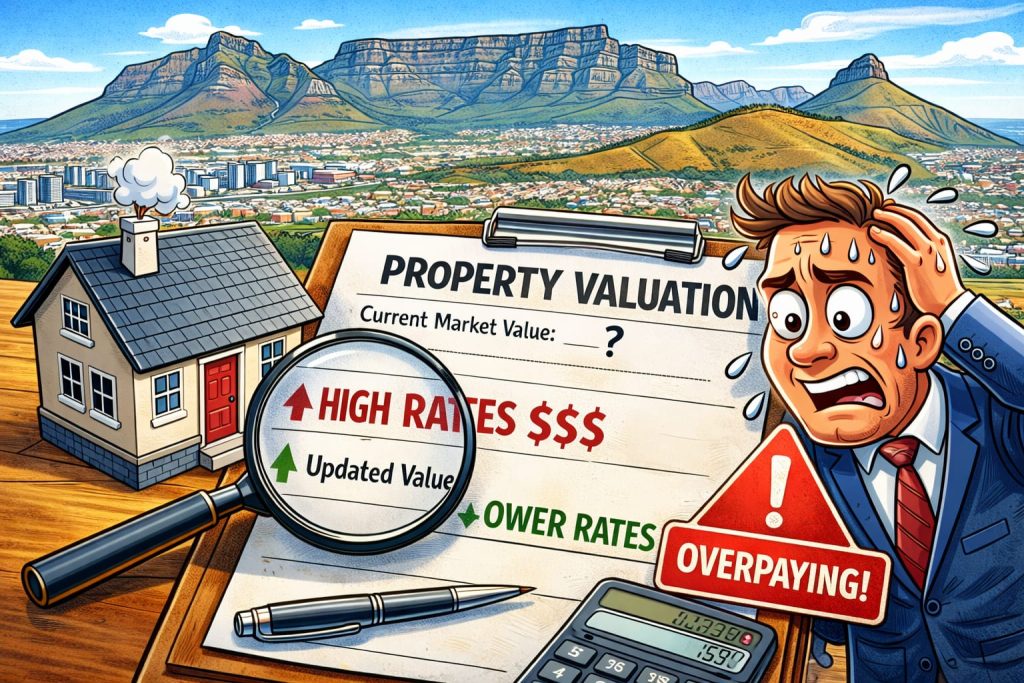
Property owners in Cape Town are entering a critical period as the city implements its latest property valuation update. The City of Cape Town is expected to publish its 2025 General Valuation Roll on 20 February 2026. Once released, property owners will have 60 days to review their municipal valuation and lodge an objection if they believe it is incorrect.Your property’s municipal valuation is used to calculate the monthly rates you will pay from 1 July 2026, based on the market value of your property as at 1 July 2025. If your property is overvalued and not challenged in time, that valuation is likely to remain in place until 2029, potentially locking in inflated rates bills for years.
Official COCT Link Here – Objecting to your property valuation
Municipal valuations directly affect how much homeowners pay in local rates and taxes, and incorrect values can significantly inflate these charges for years ahead.
Unlike traditional assessments carried out by people inspecting homes, the new valuation relies on automated systems that use limited data points — such as land size, zoning codes and basic property attributes — to estimate market values. This type of algorithmic evaluation can miss nuanced factors that influence price, like noise from nearby developments or unique features of a property.
Because these automated figures could remain unchanged until the next valuation cycle several years from now, there’s a short window — typically around two months — during which owners must review and challenge their property’s assessed worth if they believe it’s inaccurate. Missing this window means accepting whatever number the system assigns, potentially locking in higher municipal charges for the entire period.
Many Cape Town residents juggle daily financial pressures and may overlook notifications about valuation updates or fail to access the official valuation roll in time. For these homeowners, an inflated valuation not only increases monthly municipal bills but could strain household cash flow, especially among those who own valuable real estate but have tight budgets.
In high-demand areas of the city, properties tend to maintain strong market interest, which may reduce the impact on resale prospects. However, for others whose budgets are more constrained, higher local rates can make it harder to cover regular expenses or remain in their homes.
Being proactive is essential under the new approach: reviewing the valuation when it’s published, understanding how it was calculated, and taking steps to contest it if necessary. Once the objection deadline passes, the assessed value becomes effectively fixed for the next municipal valuation cycle, shaping tax bills for years.
What Homeowners Should Do Now!
Municipal property valuations can quietly lock you into higher rates for years. Here’s how to protect yourself.
1. Check Your Property’s Valuation Immediately
As soon as the valuation roll is published: (Expectation is 20 February 2026)
Look up your property on the City of Cape Town’s valuation portal
Confirm basic details: erf size, zoning, property type, improvements
Small data errors can cause big jumps in valuation.
2. Compare the Value to Reality
Ask yourself:
Is this amount realistic compared to recent sales in your area?
Has the area changed negatively (traffic, construction, noise, crime)?
Does your property have limitations the system may have ignored?
Automated valuations often miss these factors.
3. Understand the Financial Impact
Your municipal rates are calculated directly from this value:
Even a slightly inflated valuation can add up to thousands of rand over a few years
This affects monthly cash flow, especially for retirees and fixed-income households.
4. Don’t Miss the Objection Deadline
There is a strict window to object — usually around 60 days:
Missing it means the value stands until the next valuation cycle
You cannot challenge it later just because rates feel too high
Set a reminder. Treat it like a tax deadline.
5. Submit a Clear, Evidence-Based Objection
If the valuation seems too high:
Provide recent comparable sales
Point out inaccuracies in property data
Highlight external factors that reduce market value
The stronger the evidence, the better your chances.
6. Consider Professional Help (If Needed):
If the valuation difference is large:
A property professional or valuer can prepare a solid objection
The cost is often far less than the long-term savings on rates.
7. Keep Records for the Future:
Save these;
Valuation notices
Objection confirmations
Supporting documents
These help if disputes arise later or if future valuations repeat the same errors.
The Bottom Line
Municipal valuations are not just paperwork — they shape your household costs for years.
A quick review now can prevent long-term financial pressure later.